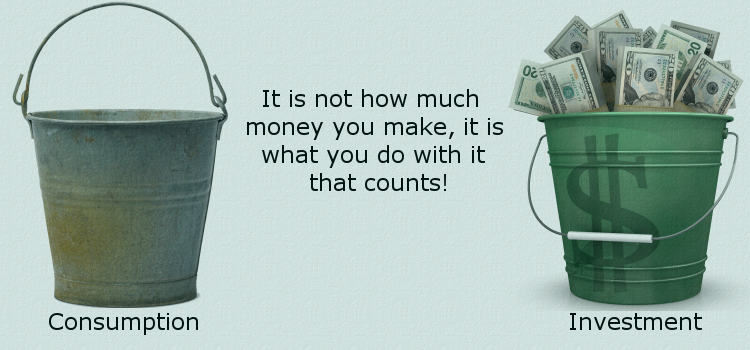
CONSUMPTION VS. INVESTMENT
The Real Path to Financial Freedom: Consume Less, Invest More
Financial freedom is often marketed as something flashy: higher income, luxury lifestyles, and the ability to buy whatever you want. But in reality, the path to true financial freedom is much quieter—and much more powerful. It comes from two simple, disciplined actions:
Cut consumption toward zero, and increase investments that grow in value.
Consumption Is a One-Way Street
Consumption feels good in the moment. New clothes, new gadgets, eating out, subscriptions, upgrades. But consumption has one defining characteristic: it always goes to zero.
The money you spend is gone forever.
The item you buy loses value or disappears.
The pleasure fades, but the cost remains permanent.
Even “small” expenses compound negatively. A daily habit of spending may not feel harmful, but over years, it represents massive lost opportunity. Every dollar consumed is a dollar that can never work for you.
Financial stress doesn’t come from earning too little—it comes from consuming too much of what you earn.
Investment Is the Opposite of Consumption
Investment behaves in the opposite way. Instead of disappearing, it compounds.
When you invest in assets that grow—such as businesses, productive skills, real estate, or long-term financial instruments—your money doesn’t vanish. It multiplies. It gains momentum over time.
Consumption ends.
Investment continues.
The key difference is this:
-
Consumption requires constant input.
-
Investment creates output.
Eventually, well-chosen investments begin to generate income, growth, or leverage without your direct effort.
Financial Freedom Is Not About Income
Many people believe financial freedom comes from earning more money. But higher income without controlled consumption only leads to a more expensive lifestyle—and the same stress.
True financial freedom happens when:
-
Your needs are low, and
-
Your assets are high
If your consumption approaches zero while your investments grow, the gap between what you need and what you own widens rapidly. That gap is freedom.
You don’t need millions to feel free.
You need low dependence on spending and high ownership of appreciating assets.
Minimal Consumption Is Not Deprivation
Cutting consumption is often misunderstood as suffering or denial. In reality, it’s about intentional spending.
You remove expenses that don’t add lasting value to your life. You stop trading long-term freedom for short-term comfort. You choose control over impulse.
As consumption decreases:
-
Stress decreases
-
Dependency decreases
-
Time freedom increases
You stop working to maintain a lifestyle and start working to build a future.
The End Goal: Assets Over Expenses
Financial freedom is reached when your investments can support your life—or when your life requires very little support at all.
When consumption is minimal and investments are growing:
-
Money stops being a source of anxiety
-
Time becomes your most valuable asset
-
Choices expand instead of shrink
This is not about being rich.
It’s about being free.
The Formula Is Simple (But Not Easy)
-
Cut consumption relentlessly
-
Invest consistently in things that grow
-
Avoid lifestyle inflation
-
Let time and compounding do the work
In the end, the people who achieve financial freedom are not the ones who spend the most—but the ones who need the least and own the most.
Consume less. Invest more. Repeat.